
Rethinking rural access: How Gloucestershire organisations are moving support closer to home
When support exists but can’t be reached
Across rural Gloucestershire, the question is rarely “Is there any support?” but much more often “Can I actually get to it?”
People looking for support often face long travel times, limited public transport, and scattered services — all shaped by a geography that quietly determines who can access help based on if a service is or isn’t available in their area.
For many, this means support exists in theory but not in practice. Over time, these barriers can lead to people going without help altogether.
These barriers become most visible when we look at how organisations are trying to support people in practice. We spoke with 7 of our funded partners to hear how they’re tackling these challenges.
Vikki Bushell from the James Hopkins Trust, which supports children with life-limiting conditions, shared a powerful example of these barriers:
“We have families that live out in the Forest that do not drive. Getting on a bus isn’t really possible because their child has extensive equipment and the journey times are so long. We would love to be able to collect the children ourselves as this feels like the compassionate thing to do. But in practice, it would be impossible to deliver effectively and equitably. […] all our staff would be on the road, no one in the building, and half their respite time would be spent travelling.“
Reconnect, led by Coryn Memory, sees similar challenges with stroke survivors. Rural isolation is more complex than the simple idea of “loneliness in the countryside.” Many people are cut off from support for a variety of reasons — fatigue, health conditions, and sheer distance.
People living with the long-term impacts of stroke often cannot drive long distances. Even when groups are technically “on a bus route,” services may be infrequent, unreliable, or simply not realistic for someone managing fatigue or mobility issues.
Counselling charity Listening Post paints a similar picture in the Forest of Dean. A single low-cost counselling session might take “an hour of travel each way” on multiple buses, making what should be a manageable commitment feel huge — especially for someone already uncertain whether counselling is “for them.”
These challenges are echoed by other funded partners. Through their stories, it becomes clear that transport is not a simple operational add-on — it’s a major barrier that no single VCSE organisation can solve alone.
As a result, many organisations are beginning to test new models of delivery, such as local hubs, outreach in community venues, and flexible one-to-one support designed around people’s lives. Their experiences offer valuable learning for anyone working to make rural services more accessible.
 Hubs, mobile models and meeting people where they are
If transport can’t be “fixed,” services themselves need to move.
Headway Gloucestershire, led by Julie Reader-Sullivan, supports people with acquired brain injury from a base in Gloucester. She described how some people were travelling up to an hour and a half to attend the rehabilitation centre — only to arrive too tired to take part fully. Transport costs also added another barrier.
In response, Headway piloted a hub model, an approach that delivers support through small, local community venues closer to where people live rather than one central site. Sessions were shortened, activities adapted, and venues chosen for accessibility and opportunities to connect with other local activities. This approach also enabled people to build local networks, helping to reduce social isolation.
Reconnect has taken a similar approach. Alongside peer groups, they offer one-to-one home befriending for people who cannot travel, as well as online groups for those who can’t consistently leave home. They also target volunteer recruitment by location, matching people with supporters in the same area to keep travel realistic on both sides.
As one Listening Post client put it:
“I had my meetings in the Forest of Dean where I live. This made a massive difference. I didn’t have to travel too far by public transport. This itself made it easier. Everything felt familiar and safe.“
For many organisations, local delivery and flexible formats aren’t nice-to-haves — they are the difference between meaningful support and no support at all.
Clean Slate Training and Employment offers another example of how organisations are using familiar local places to reach people who might not otherwise ask for support.
Although the organisation is based in Bath, it works in Gloucestershire to help people manage their money better and access the benefits they’re entitled to, working closely with local partners.
According to Lisa Woodman, Head of Business Development, Clean Slate’s coaches and peers run regular drop-ins at community hubs such as Brimscombe Mill (home of The Long Table) and South Cotswolds Food Bank. These well-known, trusted places make it easier for people to take that first step.
The in-person sessions also give people time to build confidence and get to know the team. This early trust is important, as many people go on to take part in several weeks of tailored support — often delivered remotely — to help improve their financial situation and increase household income.
By working in places people already feel comfortable, Clean Slate is able to connect with residents more easily and support lasting, positive change.
Young people, third spaces and the need for local belonging
Youth support charity The Door has learned that it is not enough to offer a youth club “nearby.” Victoria Robson, CEO, explained that young people rarely go out of their usual routes to attend youth clubs. If a club is tucked away, out of sight, or off their regular paths, they simply won’t come.
A youth centre hidden in a back street in Stroud had to close because hardly anyone used it. When the service moved to a place young people passed every day, attendance rose sharply.
This idea holds in Dursley too, where The Door’s well-attended youth club sits on a route regularly used by local young people. Another club, run at “The Tin Church” near a bus stop, drew 60–70 attendees at its busiest.
The Music Works, a youth charity providing support through music, faced a similar issue but approached it differently.
In the Forest of Dean, young people said music was important to them, yet there was almost nowhere to make it. Many were creating music alone at home because the area has few youth services and hardly any inclusive community spaces — especially for disabled young people and people with mental health conditions.
The response was to create the Forest Hub in Cinderford: a fully accessible, youth-designed music space in the town centre, complete with recording studios, production rooms, a sensory music room, and a Changing Places toilet.
Importantly, it was developed in partnership with a Youth Advisory Group of local young people facing difficult times. This meant the space reflected their tastes, cultures, and daily lives — from rap and drill to guitar-based rock.
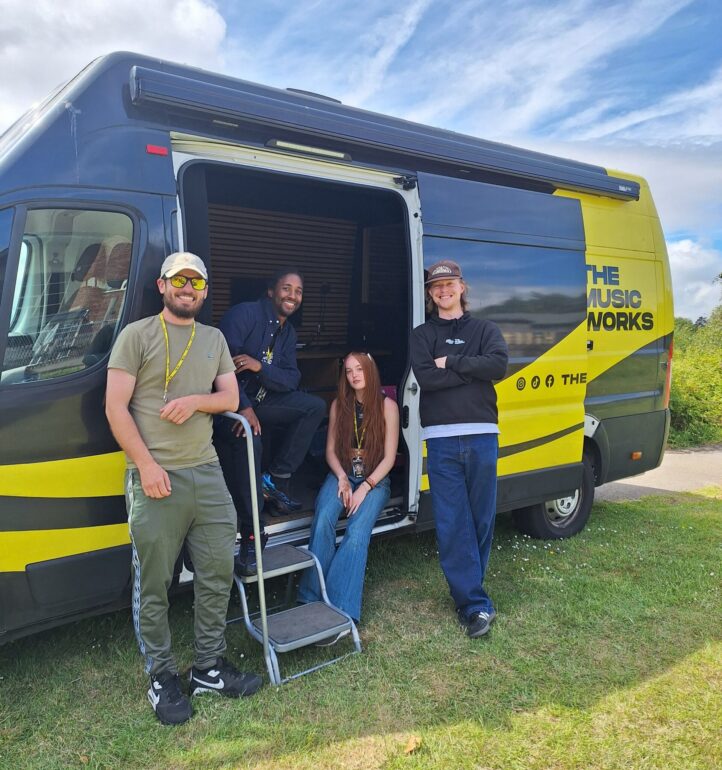
Alongside the hub, they have tested mobile and outreach approaches, taking music activities out to young people instead of asking them to travel.
This includes the Music Bus touring remote areas and Mix & Mash sessions in libraries across the county. These short, flexible sessions allow young people to take part even when they can’t travel regularly.
Rather than expecting young people to travel elsewhere to access services, both The Door and The Music Works have moved in the opposite direction — placing activities in spaces that are central, visible, and feel like their own.

What other VCSE organisations might learn from this:
- Start with people’s actual routes and rhythm.
Services work best when they are delivered in places people genuinely use. - Assume rural delivery will cost more — and design for that.
Travel, staff time and the need for smaller, local groups all increase costs. Partners stress the importance of funders recognising this from the start. - Be flexible about format.
Informal peer support framed as social activities can be more practical and less stigmatising than traditional support groups. - Think long term
Building trust in rural communities takes time. Organisations need to plan how you will stay, not just how you will start. - Use hubs and partnerships rather than trying to fix transport alone.
Working together in a place based way reduces travel problems more sustainably than any one organisation running its own transport service.
Taken together, these partners’ experiences show that rural access is possible — it just needs a different approach.
The work is often slower, can cost more, and depends on flexible, long-term funding so organisations can test and refine new idea
But as these Gloucestershire organisations show, when we redesign services around real lives and real journeys, rural communities don’t just access support — they thrive.
For Further Reading:
Allsorts Pop-Ups in Dursley: bringing play, connection and understanding closer to home – Allsorts