Learning how to make participatory research more inclusive
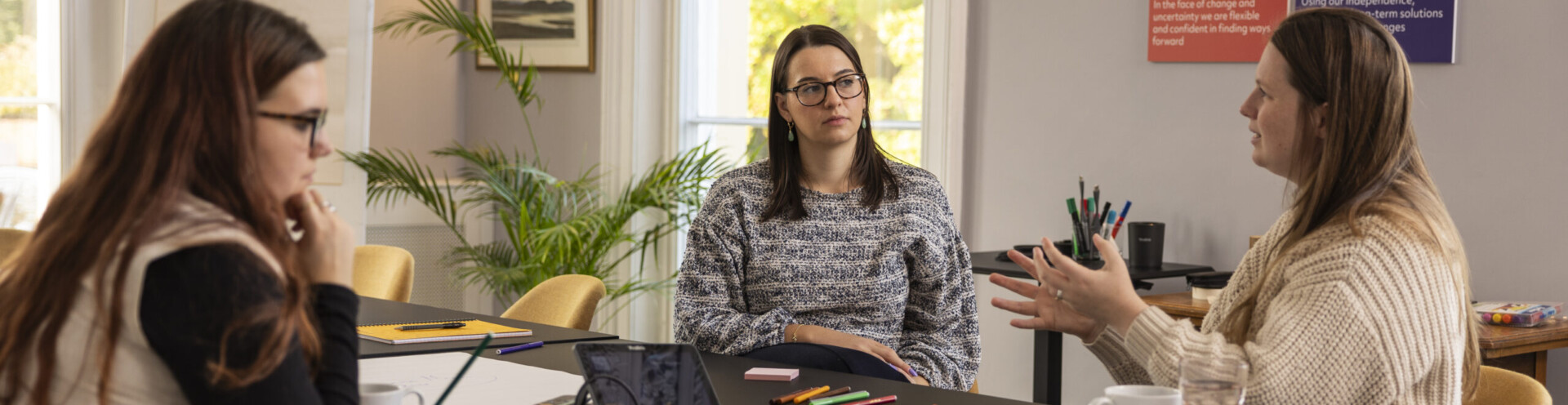
This spring, the Research Team worked with Barnwood Circle members to learn more about participatory research methods. Here’s what happened.
We want to involve people with lived experience in developing our research. In future, this could be for some or all aspects of a research project, such as co-developing the research question, supporting with data gathering and analysis, or helping to share research findings. The catch-all term for this is Participatory Research – enabling people to engage more fully and share their voices throughout the research process.
Working in this way includes using ‘participatory’ data capture methods. Traditional research methods are very often surveys or focus groups. Participatory research methods are different because they can incorporate visual, physical, or creative elements. They are designed to create an environment where people can truly express themselves and feel that their views are being listened to and valued within the research.
When planning this project, we wanted to explore what participatory research could look like for our work and how we could use participatory research methods in an accessible and inclusive way.
What we did
We started the project with an ‘Introduction to research’ session. We shared the typical structure of a research project at Barnwood and defined what participatory research means. The second session explored different participatory research methods and gave the group a chance to vote on the top 3 methods. The group chose Photo Elicitation, Journey Mapping, and Group Level Assessment.
Photo Elicitation
For this method, pre-selected photos connected to the research project are used in combination with questions to guide the interview. The photos act as a visual aid to support the person being interviewed in sharing their thoughts and reflections on the topic.
When we tested this method, we conducted interviews with each group member on a hypothetical research project. The interviewer presented 12 pre-selected images and asked the person being interviewed to select the photos they wanted to discuss. We wanted to test variations of this method, so we also tried adding recorded sounds and an object. For example, for a project on “Community Spaces”, we used 12 images of different spaces in the county, sounds of things like a bicycle bell or birdsong, and a book as a physical object.
Example image and questions for an interview

Journey Mapping
Journey Mapping can be used in either an interview setting or in a small group. We wanted to test this method in a small group to understand the impact of having multiple people discussing their different perspectives on the same journey. A Journey Map offers a structure to map someone’s experience of an event or situation over time. For example, you can map how someone’s feelings change over the course of a workday. These maps highlight where a person, or group of people, have similar or different experiences, and help to show where things could be improved.
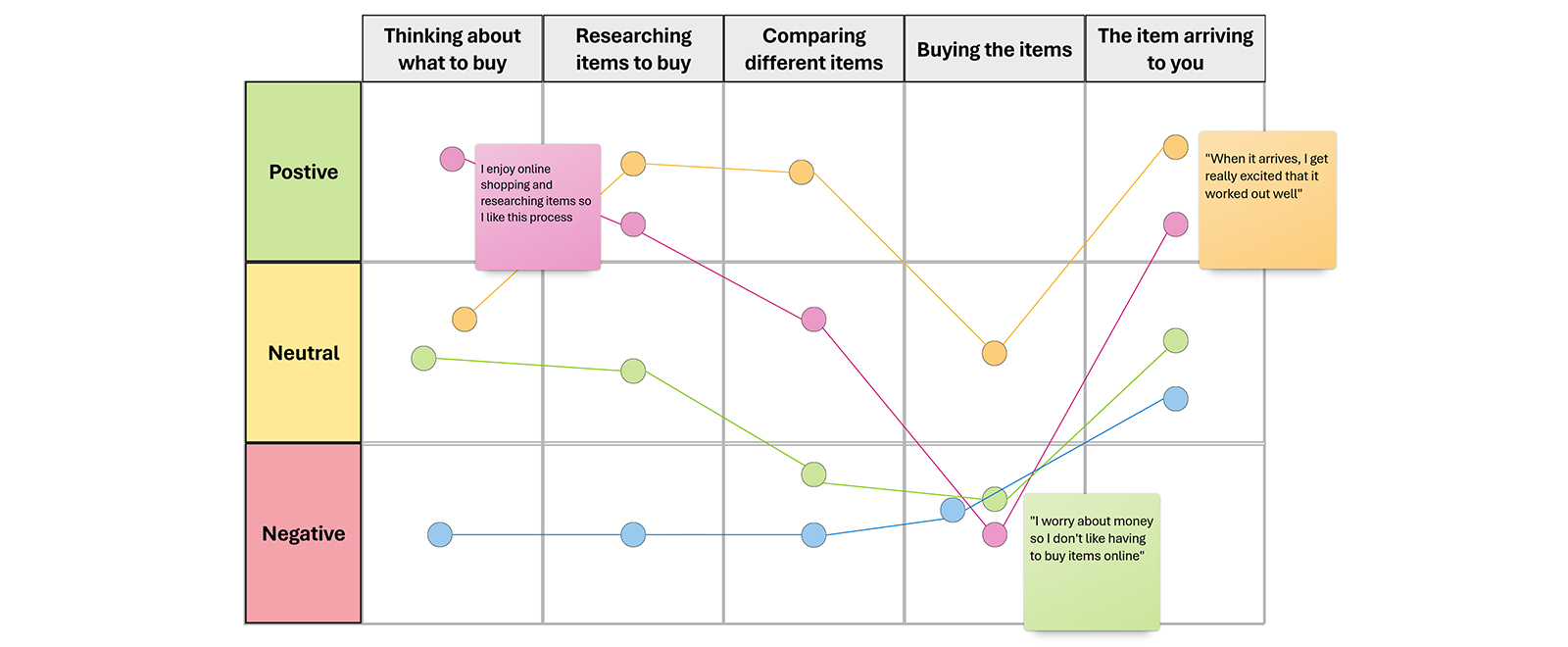
When we tested this method, we made two different maps with the group. One map was simpler and tracked how someone felt (positive, negative, or neutral) during 5 stages of buying a gift online. Each person would explain how they felt at each stage and a facilitator would draw a circle in the row and column that best aligned with their experience.
Example of a simple Journey Map
We also tested a more detailed version of a journey map, which tracked several categories during the different stages of travelling away for the weekend. These categories included: how someone felt during the journey, the actions they took, any challenges they encountered, opportunities for improvement, and any accessibility aspects they considered. As the group discussed the categories in each stage, the facilitator transcribed the discussions onto post-it notes, which were displayed on the map.
Example of a more detailed Journey Map

Group Level Assessment
This method is often used with a large group (approximately 40 people or more) over the course of a day. Research questions are placed around a room, and people are invited to share and write down their reflections. After everyone has a chance to contribute, they are split into small groups to investigate further.
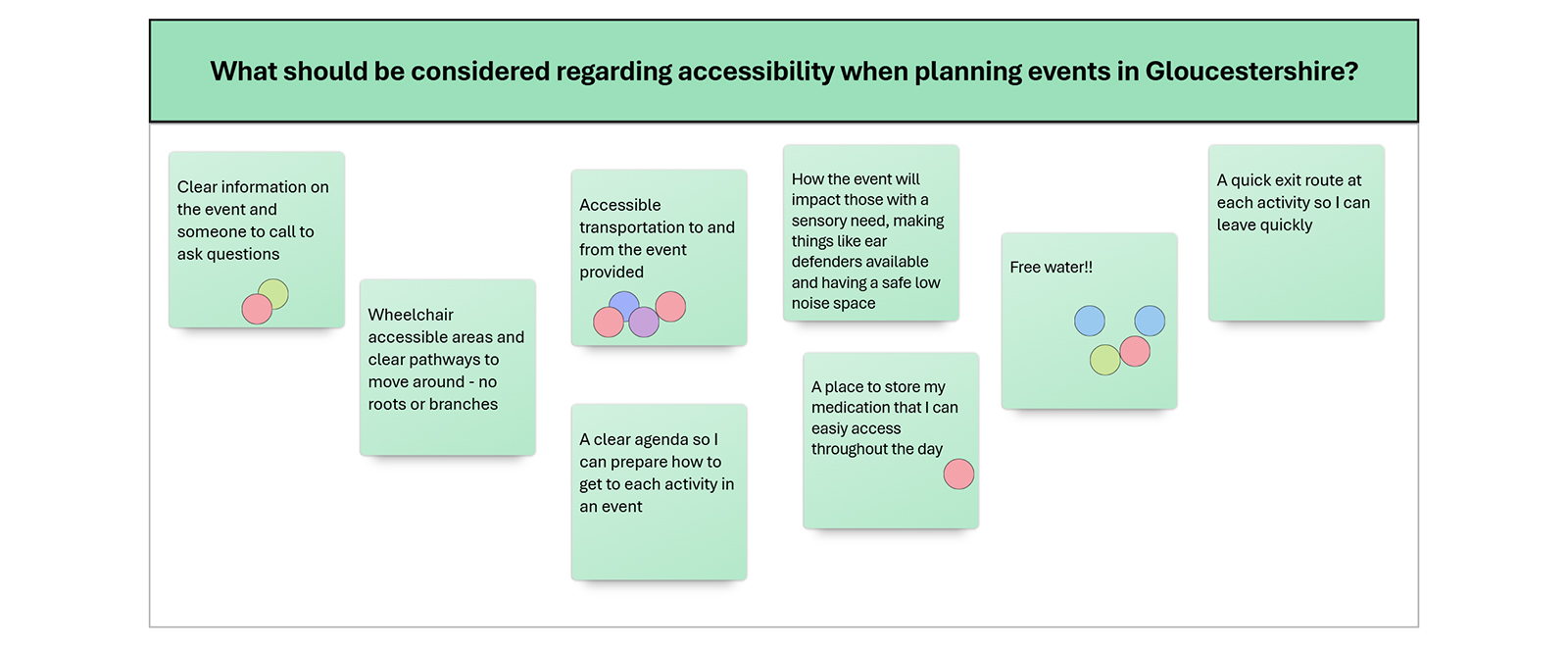
When testing this method, we created 3 stations, each with a research question, and a facilitator to write down people’s thoughts and discussions. After reflections were added, the group broke out into small groups and rotated between the questions, discussing and finding common themes.
Example of a Group Level Assessment question board
What we learnt
Photos Elicitation
The group felt that photo elicitation was a valuable tool for helping people share their thoughts during an interview and they appreciated the opportunity to choose the photos that guided the conversation. When sounds were used, there was less energy in the conversation; however, some people still found it a helpful prompt. The group suggested a possible adaptation could be to add a written description for the images and sounds to provide the person being interviewed with more context. They also felt that in future projects, we could involve experts by lived experience in the process of picking the photos and co-designing the interview questions.
Journey Mapping
The group fed back that discussing their journeys in a small group helped them share their experiences – this was true for both the simple and detailed journey maps. When working with the simple map, people found it helpful to refer to earlier stages to explain how and why their feelings changed over time. For the more detailed map, the clear structure supported people to describe and discuss their journeys. Overall, however, the group felt that the simple map provided a better visual representation of the journeys. Some suggestions for improving the accessibility of the simple map included making the maps larger and clearer or creating a digital version to be used during the group session. Another idea was to have people fill out maps independently and come together to compare them.
Group Level assessment
The group felt that the stations used in the first part of this method worked well, giving people an opportunity to talk through ideas before a facilitator wrote them down. At times, the facilitators felt it was difficult to accurately record someone’s response as they were speaking. To help with this, facilitators asked each person if what was written down accurately reflected what they had said. When the group broke out into smaller groups, people shared more individual experiences and also reflected on what others had written. However, some people found it difficult to connect individual comments to themes.
Overall learnings
In addition to learning about each of the methods, we developed a better understanding of how to conduct participatory research in general. We also learned more about communicating the value of research to the people we are engaging with and how to better support their involvement.
Feedback from the group highlighted the positive impact of taking the time to explain how their input influences our research practice and the difference it makes in our research. We also recognised the importance of building in enough time to carry out engagement for our research. We are at the beginning of our journey in developing our participatory research practice and look forward to learning more as we continue this work next year.
If you have any questions about this project or would like to talk about our participatory research practice, please get in touch with the research team at research@barnwoodtrust.org